





 +60173309581
Study in Malaysia for Indian Students in 2026: Honest Guide
June 21, 2026
Mehmil

Here's something we're noticing: more and more Indian students are starting to ask about Malaysia.
And honestly? It makes a lot of sense once you dig into it.
Cheaper than the UK or Australia. English-taught degrees. A real tech scene in Cyberjaya.
And unlike a lot of countries, Malaysia actually lets Indian graduates stick around and work after their studies through its Graduate Pass.
It's quickly becoming one of the most promising study-abroad markets for Indian students — and we want you to make this decision with the full picture, not just the highlight reel.
So let's break down what studying in Malaysia for Indian students actually looks like in 2026.
Why Are Indian Students Choosing Malaysia?

If you're exploring options to study abroad, Malaysia might not be the first country that comes to mind. But spend ten minutes looking into it, and you'll see why a growing number of Indian students are picking it over the usual UK, Australia, or Canada route.
Here are few practical reasons why;
1. Cheaper Than the UK, Australia, Canada
Let's talk numbers first, because that's usually what decides this for most Indian families.
A full bachelor's degree at a private university in Malaysia typically costs somewhere between RM 30,000 and RM 1,20,000 (roughly INR 5.5 lakh to 22 lakh) for the entire programme, depending on the course and university. Compare that to the UK, Australia, or Canada, where you could easily pay that same amount in tuition for just one year.
Cost of living in Malaysia runs significantly lower too; accommodation, food, and transport in Kuala Lumpur or Cyberjaya cost a fraction of what you'd spend in London, Melbourne, or Toronto.
Several Malaysian universities offer UK-validated or Australian-partnered degrees. That means you can study a UK or Australian curriculum, get a degree recognised by that partner university, and pay Malaysian tuition fees the entire time. Taylor's University and Sunway University both run programmes like this.
2. A Real Tech and Business Hub
Here's something people don't expect: Malaysia has actually built a serious tech ecosystem.
Cyberjaya, just outside Kuala Lumpur, was purpose-built as Malaysia's technology township, and it's home to Asia Pacific University (APU), one of the most popular choices for Indian students looking to study computer science, AI, data science, or cybersecurity.
If you'd rather study technology in a more traditional engineering-and-research setup, Multimedia University (MMU) is worth a look too, it's one of Malaysia's older private universities with a long track record in computing and engineering.
On the business side, Taylor's University and Sunway University are known for hospitality, business, and finance programmes, with international rankings and partnerships to back it up.
The point here is that you're not choosing Malaysia because nowhere else would take you — you're choosing it because it offers a legitimate, modern, English-taught education in exactly the fields most Indian students are actually applying for.
3. You're Closer to Home Than You Think
This one's simple, but it matters more than people realise until they're three months into a semester and missing home.
A direct flight from Delhi to Kuala Lumpur takes about 5.5 hours. From Mumbai or Chennai, it's even shorter. Compare that to a 16–20 hour journey (often with a layover) to the UK, US, Canada, or Australia.
What does that actually mean for you?
- You can fly home for a long break without burning your entire holiday in transit.
- Your parents can visit without planning a once-in-a-lifetime trip around it.
- Flights are cheaper too, simply because the distance is shorter.
It sounds like a small thing until you're the one calculating how many days of your two-week winter break you'll lose just getting there and back.
4. One of the Few Nationalities With Graduate Pass Access
Here's something that genuinely sets Malaysia apart for Indian students specifically: post-study work access.
Most countries that offer a "stay back and work" option after graduation only extend it to a short list of nations. Malaysia's version of this, called the Graduate Pass, lets international graduates stay in the country for 12 months after finishing their degree to look for work, without needing an employer to sponsor them first.
And India is one of the nationalities that currently has access to it.
We'll go into the full details, including some real conditions you need to know about, later in this guide.
What Does It Actually Cost to Study in Malaysia from India?
This is usually the first question Indian families ask — and it deserves a straight answer with real numbers, not vague ranges.
Private university fees in Malaysia vary a lot depending on the institution's reputation and the course you pick. Here's how it breaks down for Indian students:
| Tuition Cost Category | Example Universities | Typical Annual Tuition (MYR) | Annual Tuition (INR Approx.) |
|---|---|---|---|
| Higher-Cost Private Universities | RM 30,000–60,000+ | ₹6.9–13.8 lakh+ | |
| Mid-Range Private Universities | RM 18,000–40,000 | ₹4.1–9.2 lakh | |
| Budget-Friendly Private Universities | RM 10,000–20,000 | ₹2.3–4.6 lakh |
NOTE: All figures used an exchange rate of 1 MYR ≈ ₹23 (mid‑2026 rate). Rates fluctuate, so treat these as planning estimates, not exact quotes.
These figures cover tuition fees only. Your total study cost will also include accommodation, food, transportation, and one-time setup expenses, which are explained below.
Monthly Living Costs in Malaysia
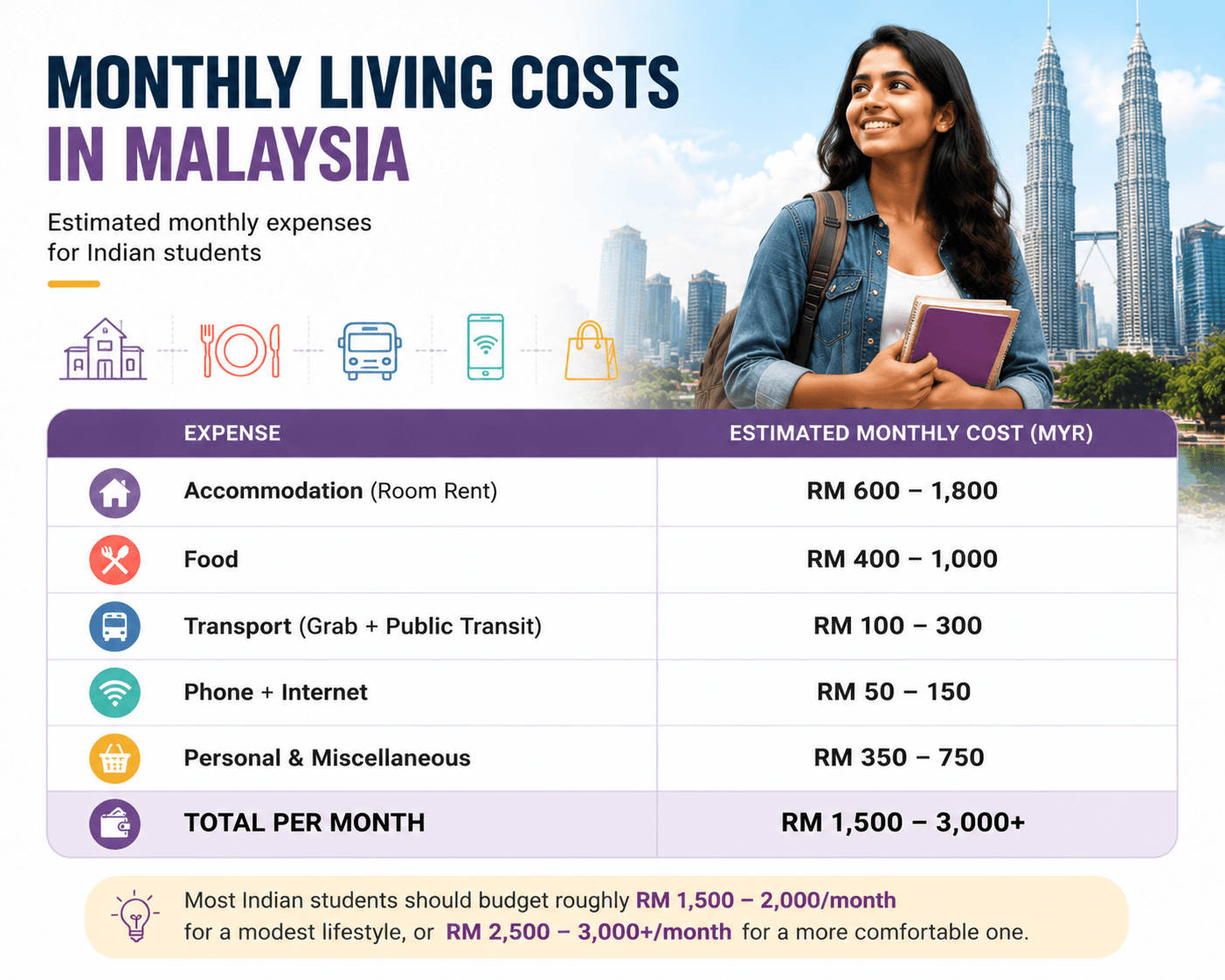
Living costs depend heavily on your accommodation choice and city. Kuala Lumpur and Cyberjaya tend to run higher than Penang or Johor Bahru.
| Expense | Budget Lifestyle (MYR) | Comfortable Lifestyle (MYR) | Budget (INR) | Comfortable (INR) |
|---|---|---|---|---|
| Accommodation (Room Rent) | RM 600–900 | RM 1,200–1,800 | ₹13,800–20,700 | ₹27,600–41,400 |
| Food | RM 400–600 | RM 700–1,000 | ₹9,200–13,800 | ₹16,100–23,000 |
| Transport (Grab + Public Transit) | RM 100–200 | RM 200–300 | ₹2,300–4,600 | ₹4,600–6,900 |
| Phone + Internet | RM 50–100 | RM 80–150 | ₹1,150–2,300 | ₹1,840–3,450 |
| Personal & Miscellaneous | RM 350–500 | RM 400–750 | ₹8,050–11,500 | ₹9,200–17,250 |
| Total Per Month | RM 1,500–2,000 | RM 2,500–3,000+ | ₹34,500–46,000 | ₹57,500–69,000+ |
Most Indian students should budget roughly ₹35,000–46,000/month for a modest lifestyle, or ₹57,500–69,000+/month for a more comfortable one.
One-Time First-Year Costs You Shouldn't Forget
These hit once (or once a year), but students routinely forget to budget for them — and they add up fast:
- EMGS student pass processing fee: approx. RM 4,000 (₹92,000-₹95,000)
- Medical examination in India (pre-departure): approx. ₹3,000–6,000
- Return flights (India–Kuala Lumpur): approx. ₹18,000–35,000, depending on city and season
- Accommodation deposit: usually 1–2 months' rent upfront, RM 400–2,400 (₹9,200–55,200)
- Settling-in costs: bedding, kitchen basics, local SIM, initial groceries, budget RM 500–800 (₹11,500–18,400)
University hostels can save you more than you'd expect. Students who choose university-managed hostels over private apartments typically save RM 400–800/month (₹9,200–18,400). Spread across a 3-year degree, that's a meaningful chunk of savings, worth weighing before signing a private rental lease.
Which Malaysian University Is Right for You? (Honest Breakdown)
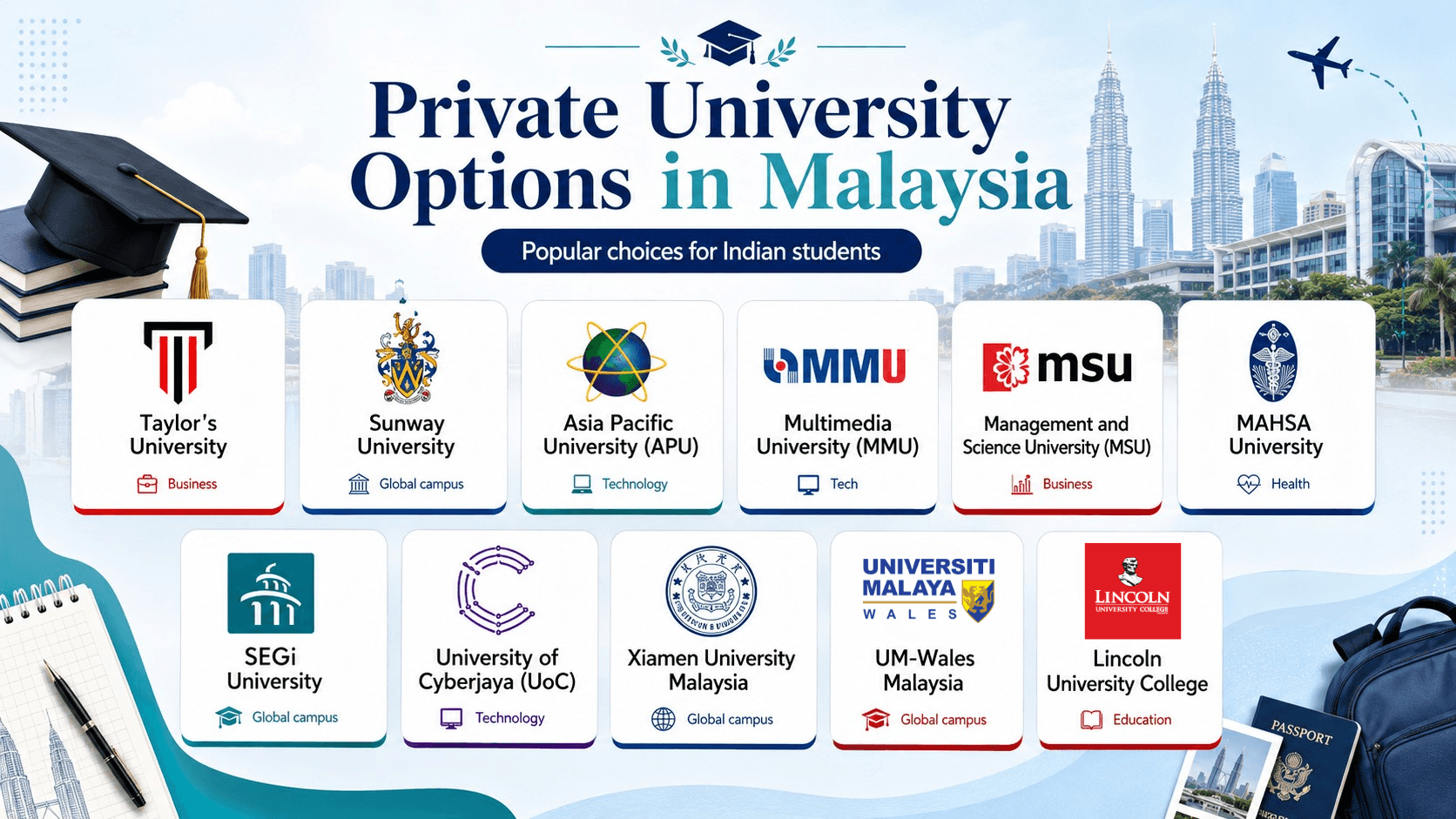
There is no single "best" university in Malaysia. The right one depends on your budget, your course, and what you want to do after graduation. Here's the honest breakdown.
1. Universities With the Strongest Global Reputation
Taylor's University and Sunway University sit at the top for a reason. Both have strong QS rankings, modern campuses, and real industry connections. Sunway partners with Lancaster University, and Taylor's has tie-ups across the UK, Australia, and beyond. Taylor's is especially known for hospitality, business, and engineering; Sunway is strong in business, computing, and AI.
Yes, they cost more. But if your family can comfortably manage the fees, this is where you get the best campus experience and the strongest resume value, particularly if you're eyeing jobs in Malaysia, the Gulf, or senior roles back in India.
👉 Best for: students who want the strongest career profile and can afford the premium.
2. Strong Academics at a Manageable Cost
This is where most Indian students actually land, and honestly, it's a smart place to be.
| University | Strong Areas |
|---|---|
| Asia Pacific University (APU) |
IT Computing Data Science Cybersecurity
|
| Multimedia University (MMU) |
Engineering Computing Multimedia
|
| UCSI University |
Pharmacy Nursing Architecture Engineering
|
| MAHSA University |
Medicine Dentistry Nursing
|
| Management & Science University (MSU) |
Business Health Sciences Education
|
| University of Cyberjaya (UoC) |
Medicine Health Sciences Computing
|
These universities give you solid academics, decent facilities, and good graduate outcomes without the Tier 1 price tag.
👉 Best for: students who want a recognised degree and good career prospects without overstretching the budget.
3. Budget-Focused Options
Universities like Lincoln University College are legitimate and accredited. But let's be real, they don't carry the same weight as Tier 1 or Tier 2 names when it comes to rankings or employer recognition.
They make sense if:
- Budget is your biggest constraint
- You're planning to build skills through internships alongside your degree
- You're okay with lower brand recognition in exchange for lower fees
👉 Best for: students prioritising affordability who have a plan to make up the gap with practical experience.
🩺 MBBS in Malaysia for Indian Students: Read This Before You Decide
Medicine is Malaysia’s most popular course among Indian students, but not every MBBS degree is NMC-recognised for practice back home. MAHSA University, University of Cyberjaya, and UCSI University are among the universities that meet this requirement.
Scholarships in Malaysia: What's Real and What Isn't
We need to talk about this, because a lot of Indian students arrive in Malaysia with the wrong expectations, and it causes real financial stress.
Most Malaysian private universities only offer a partial tuition fee waiver; typically between 20% and 50% off the published tuition rate. This is not a full grant. It does not cover accommodation, food, or living expenses.
A full scholarship, one that covers tuition plus living expenses, is extremely rare at Malaysian private universities. It is just important that you understand what you are being offered before you sign anything.
What You Can Realistically Expect:
- Merit-based tuition waivers: 20–50% off tuition, available at most universities for students with strong Class 10 / Class 12 marks (typically 85%+ aggregate, depending on the university and board)
- Malaysia International Scholarship (MIS) for PG Studies: Full funding including tuition and a monthly stipend but this is postgraduate only, highly competitive, and limited in seats.
Do You Need IELTS to Study in Malaysia from India?
Short answer: not always but do not assume you are off the hook without checking.
When IELTS Is Required?
Most universities require a formal English proficiency test for admission:
- Taylor's University: IELTS 5.5–6.5 (varies by programme)
- Sunway University: IELTS 5.5–6.0 minimum
- APU, MSU, UCSI: IELTS 5.5–6.0 for most undergraduate programmes
- MAHSA (MBBS): IELTS 5.5–6.0 typically required
- Postgraduate programmes: generally IELTS 6.0–6.5
When IELTS Can Be Waived
There are legitimate pathways that do not require IELTS:
- Medium of Instruction (MOI) certificate: If you studied in an English-medium school or college in India; such as CBSE, ICSE, or state board institutions where instruction was conducted entirely in English, your school or college can issue a certificate confirming this. Many universities accept this in place of IELTS.
- University internal English test: Some universities conduct their own English placement test as an alternative.
- English pathway programme: You join a pre-sessional English course at the university first, then progress to your main degree.
Do not assume the waiver applies to your chosen university or programme without confirmation. Always apply for the waiver officially and ensure it is confirmed in writing before accepting your offer. A missing IELTS requirement discovered late can delay your entire intake.
Malaysia Student Visa for Indian Students: Step by Step
The Malaysia student visa process is well-organised and has a high approval rate for Indian students, approximately 90–99% when documents are complete and accurate.
The visa is managed through EMGS (Education Malaysia Global Services), a government agency under Malaysia's Ministry of Higher Education. Your university handles the EMGS submission. So, you do not apply directly.
Here is exactly how it works:
→ Step 1: Apply to your chosen university with EasyUni's help and receive your eligibility letter.
→ Step 2: Pay the EMGS fee, approximately MYR 4,000 and send your proof of payment to us. We forward it directly to the university.
→ Step 3: The university verifies the payment. Once confirmed, your student visa process officially begins.
→ Step 4: Submit your full set of documents for the student visa application (full checklist below).
→ Step 5: Your student visa is now being processed, this typically takes 4–6 weeks.
→ Step 6: Once approved, you receive your eVAL (electronic Visa Approval Letter).
→ Step 7: Apply for a Single Entry Visa (SEV), this takes approximately 3–4 working days and costs around MYR 120. This is usually processed quickly, but build in a buffer week before booking flights.
→ Step 8: Book your flight to Malaysia. Do not fly earlier than 2 weeks before your intake start date.
Documents Checklist for Indian Students
✅ Valid passport: Minimum 18 months' validity from your course start date
✅ Academic certificates (attested/notarised copies): For Foundation or Diploma: only Class 10 mark sheet/certificate is required, For Bachelor’s degree: both Class 10 & Class 12 mark sheets/certificates are required
✅ IELTS certificate (or MOI certificate if applying for waiver)
✅ Offer letter from your Malaysian university
✅ Passport-sized photographs (4–6 copies)
✅ Completed health declaration form
✅ Medical examination report from EMGS-approved clinic
EMGS has processed student visa applications in as little as 7–14 working days when all documents are submitted correctly on the first attempt. However, delays often happen due to incomplete documents and inconsistent bank statement balances.
It is strongly recommended to start preparing your documents at least 10–12 weeks before your course start date instead of leaving it until the last 3–4 weeks. Many students miss their intake simply due to late preparation.
Can You Work During and After Your Studies?
This section matters. Read it carefully before making any decisions.
Part-Time Work During Your Studies
Yes — you can work part-time in Malaysia as an international student, but within specific rules:
- You may work up to 20 hours per week but only during semester breaks and official holidays that are longer than 7 days
- You cannot work during active academic semesters without special permission
- You must hold a valid Student Pass to be eligible
- Typical jobs available: food and beverage, retail, campus-based jobs, tutoring
The honest caveat: Malaysia is not Australia or the UK when it comes to student work rights. In those countries, students can work during semesters and support a significant portion of their living costs through part-time jobs. In Malaysia, work during breaks provides supplemental income for personal expenses, it is not a funding strategy for tuition or rent.
After Your Studies: The Graduate Pass
Here’s something worth knowing if you’re Indian: Malaysia extended its Graduate Pass scheme to Indian nationals (alongside Chinese nationals), valid until 31st December 2026, allowing eligible graduates to stay on in Malaysia after completing their studies, subject to case-by-case approval and additional conditions.
Here’s how it actually works:
- The pass gives you 12 months from graduation to stay in Malaysia legally; this is a one-time window and cannot be renewed
- You do not need a job offer or employer sponsor to apply for the pass itself, it is designed for the job search period
- Only Bachelor’s degree holders and above are eligible, diploma graduates do not qualify
- As an Indian national, you will need a letter of good conduct from either your university or the Indian High Commission, in addition to the standard documents (passport, proof of graduation, medical insurance, personal bond, and a Malaysian sponsor declaration)
- The Graduate Pass itself does not let you work full-time. If you secure a job within those 12 months, your employer must then sponsor you for an Employment Pass, and you need to make that switch before your Graduate Pass expires
- If the 12 months run out before you find a job, there is no extension, you would need to leave Malaysia and explore other visa routes to return
This is a genuine post-study option, and a real safety net if you want time to job-hunt rather than flying home the moment your course ends. But it is not automatic, not guaranteed, and not indefinite, so treat it as a year-long runway to plan around, not a long-term stay.
Some Local Tips for Settling In Once you Arrive
🚗 Transport Tip
Download Grab before you land. It’s Malaysia’s main ride-hailing app and essential for student travel outside campus.
🏦 Banking
Open a local bank account in your first week. Maybank and CIMB are widely used. For sending money from India, ask your bank about LRS remittance limits in advance.
📚 Study Style
Malaysian universities use continuous assessment like assignments, group work, and presentations, not just final exams.
🌤️ Weather
The climate is hot and humid year-round. Stay hydrated and ensure proper ventilation in your accommodation.
🏥 Health Insurance
Insurance is included via EMGS. Your university international office will guide you on how to access medical care.
💡 Student Insight
Budget for small daily expenses early; things like transport and food add up faster than expected.
How EasyUni Can Help You Study in Malaysia
Applying to a university in another country can be confusing, especially when you're comparing dozens of courses, universities, tuition fees, scholarships, and visa requirements.
Our advisors work closely with Malaysian universities and help students find options that match their academic background, budget, and career goals.
What EasyUni Can Help With
✅ University and course recommendations based on your goals
✅ Comparing tuition fees, scholarships, and living costs
✅ Checking admission requirements before you apply
✅ Assisting with university applications
✅ Guiding you through the student visa process
✅ Helping you understand offer letters and next steps
Why Students Trust EasyUni
The biggest advantage is having access to experienced advisors who understand the Malaysian higher education system and can help you navigate the process more confidently.
- Our services are 100% free, and there is no additional fee for receiving advice or application support.
- And most importantly, we stay in contact after you arrive — you are not left alone once you land.
💬 Need Help Choosing the Right Path?
Speak to an EasyUni advisor or message us on WhatsApp for instant guidance on courses, universities, and applications in Malaysia.
Frequently Asked Questions
1. Is Malaysia good for Indian students?
Yes, for the right reasons. Malaysia offers English-medium degrees, globally recognised qualifications, a large Indian community, and tuition fees that are a fraction of what you'd pay in the UK, US, or Australia. It's not the right fit if you're chasing a Western-country post-study visa or permanent residency pathway; Malaysia is better suited to students prioritising affordability, cultural comfort, and academic quality over long-term migration.
2. How much does it cost to study in Malaysia for Indian students?
Tuition for undergraduate programmes typically ranges from INR 2.5 lakh to INR 10 lakh per year, depending on whether you choose a public or private university and the course. Public universities are generally cheaper. Add living expenses of roughly INR 20,000–30,000 per month for accommodation, food, and transport, and total annual costs (excluding tuition) usually fall in the INR 2.5–4 lakh range.
3. Do Indian students need IELTS to study in Malaysia?
Not always. Most universities will waive IELTS if you can produce a Medium of Instruction (MOI) certificate confirming your prior education was conducted in English, which is common for CBSE, ICSE, and many state board students. Where IELTS is required, the typical band requirement is 5.5–6.0 for undergraduate programmes.
4. Is a Malaysian degree valid in India?
Generally yes, provided the university and programme are properly accredited, for example by the Malaysian Qualifications Agency (MQA), and the degree is from a recognised institution. For professional fields like medicine and engineering, recognition in India depends on additional licensing steps; for engineering, Malaysia is a signatory to the Washington Accord, which supports mutual recognition with NBA-accredited Indian institutions.
5. Is MBBS in Malaysia valid in India?
It can be, but it isn't automatic. The university must be properly recognised, and you will still need to clear India's licensing exam (NEXT, formerly FMGE) to practise medicine in India after returning. NEET eligibility before you go is also treated as essential if you want to keep your India-practice options open, so this is worth confirming with an education consultant before committing to a specific medical university.
6. Can Indian students get a scholarship to study in Malaysia?
Most universities offer partial tuition fee waivers of 20–50% based on your Class 10/12 academic record, not a full scholarship covering living costs. The Malaysia International Scholarship (MIS) does offer full funding plus a stipend, but it's postgraduate-only, highly competitive, and limited in seats.
7. Can Indian students work while studying in Malaysia?
Yes, but only part-time and only during semester breaks or holidays longer than 7 days, up to 20 hours per week. You must hold a valid Student Pass to be eligible, and this income is meant to cover personal expenses, not tuition or rent.
8. How long does the Malaysia student visa take for Indian students?
The full process, from EMGS submission to receiving your eVAL, typically takes 4–6 weeks, though it can extend to 8 weeks during peak intake periods. It's best to start preparing documents at least 10–12 weeks before your course start date to avoid missing your intake.
9. Can Indian students stay in Malaysia after graduation?
Malaysia currently extends its Graduate Pass scheme to Indian nationals (valid through 31 December 2026), allowing eligible Bachelor's degree holders and above to stay for up to 12 months after graduation to job-search. It's approved case-by-case and is not renewable, so it's a job-search window, not a long-term stay option. Malaysia does not currently offer a broader, guaranteed post-study work visa beyond this scheme.
10. Which is the best university in Malaysia for Indian students?
There's no single "best" university, it depends on your course and budget. Universiti Malaya (UM) leads on global rankings and research; Taylor's University and Sunway University are popular among Indian students for business, hospitality, and biomedical sciences; Asia Pacific University and MSU is a strong choice for computer science, AI, and cybersecurity.
Kickstart your education in Malaysia
We'll help you find and apply for your dream university
You might be interested in...
- Semester Break Exploration Guide For International Students in Malaysia
- International Students' Guide to Success in Malaysian Research Programs
- Top Actuarial Science Universities in Malaysia for International Students 2026
- Updated: Malaysian universities continue to make progress in THE World University Rankings 2023
- Is an MBA Worth It? 5 Pros and Cons You Should Consider in 2026
- Choosing the right university and course in Malaysia
- Types of English Language Proficiency Tests in Malaysia
- 8 Good Study Habits For University Students
- 6 Effective Time Management Skills Tips For Students
- Choosing Between Public or Private University in Malaysia: What is your choice?